
Retail investors now own a bigger slice of smallcap companies than at the start of 2023-24 (FY24), underscoring their growing conviction about investing in this red-hot space. Data from Capitaline shows mutual funds' (MFs') average holding in the National Stock Exchange Nifty Smallcap 250 rising to 9.26 per cent from 8.67 per cent during the first six months of FY24, with the number of companies with over 20 per cent MF holdings increasing from 24 to 28. In comparison, MF holdings in Nifty50 companies have gone up only marginally, from 9.67 per cent to 9.75 per cent.

Public sector banks are increasingly looking at promoter funding as a business opportunity when others are shying away from it.

Asset quality stress has ballooned recently, as growth slowed and interest rates continued to rise.

The stress in the banking sector, which mirrors the stress in the corporate sector, has to be dealt with in order to revive credit growth.

A rate change seems round the corner, no matter where the new base level is fixed.

Latest figures for HDFC Bank aren't available.
Shares of most European banks are down significantly.

With March 2016 being the final quarter when banks will have to disclose their stressed assets, the markets are assuming the worst is yet to come

For non-banks, the IL&FS crisis was nothing short of India's Lehman moment, which has for a foreseeable future reset the sector on multiple grounds.

So, what does 2016 have in store for the Indian markets? Will they be able to take a giant leap forward in the leap year, and what are the key risks?

'Investors should focus on largecap funds, flexicap funds, business cycle funds, or hybrid-category funds.'

The octogenarian, who has already announced his retirement from electoral politics, is sought to be put on the pedestal by the governing party's central leaders.

Even as the slowdown in the information technology (IT) services sector deepens, banking, financial services and insurance (BFSI), as well as oil and gas companies, emerge as the primary drivers of corporate earnings in the country. The IT services sector's share in corporate earnings declined to a five-year low of 17.4 per cent in the second quarter (Q2) of 2023-24 (FY24), whereas banks and finance companies accounted for 46.5 per cent, and oil and gas firms contributed 16.8 per cent. At their peak, IT services firms like Tata Consultancy Services (TCS), Infosys, HCLTech, and Wipro represented just over a third of the combined net profit of all listed companies in the Business Standard sample.

The share of foreign companies in private sector investments, directed towards building new factories and other facilities, has declined over the past six months. A mix of large domestic announcements and relatively lower growth in foreign capital expenditure (capex) plans have played a role, although foreign investments remain near record levels. The share of foreign companies in the overall private sector investments over the four quarters ended June 2023 has dipped to 14.9 per cent, as shown by a Business Standard analysis of data from the project tracker Centre for Monitoring Indian Economy.

Floating-rate mutual funds are back in demand after a year-long period of consistent outflows. In the past three months, investors have poured over Rs 6,100 crore into these debt schemes, indicating a reversal in fortunes for the category that recorded outflows for 11 consecutive months (May 2022 to March 2023), totalling Rs 32,250 crore. Floating-rate funds invest at least 65 per cent in floating-rate instruments, which have their interest rates linked to the Reserve Bank of India repo rate.

Budget 2015 has blessed the banking sector.
The banking sector, which had seen good set of numbers in the third quarter, is likely to report subdued earnings in the fourth quarter of 2008-09 due to slowdown in credit growth and pressure on interest margins, analysts say.

Highly-rated finance firms and housing finance companies are expected to benefit from the absence of Housing Development Finance Corp (HDFC) from the bond market once it merges with the HDFC Bank in early FY24. Post merger, the bond market is expected to become less crowded, which will ease fund raising conditions for other players in the field. It may perhaps also compress the spread for debt instruments floated by housing finance companies (HFCs) over 10-year government bonds, subject to demand and supply conditions.

Experts foresee possible scenarios: A BRS government with less majority, a BRS government with BJP and AIMIM support, or a Congress government.

Unless RBI temporarily relaxes the norms on recognising of bad loans, the pressure on this front could rise in the December quarter.

Sectorally, telecom, realty, auto and banks were among the top losers, shedding as much as 2.22 per cent.
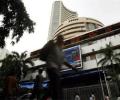
Broking firm Jefferies says Indian financial system is now flooded with the kind of liquidity witnessed in 2005-07 and 2009-10

The current slowdown has lasted for over 18 months and is the longest incident of sluggishness since 2006.

YES Bank, Bank of Baroda, SBI, IndusInd Bank, and RBL Bank are amongst the banks, Jefferies says, are most prune to "high risk" emanating from ADAG, Cox & Kings, CG Power, DHFL and Essar Shipping.

ICICI Bank has the largest proportion of SDR loans as a percentage of its total, followed by state-run United Bank of India and Canara Bank.

The management, however, is a bit wary about near-term performance.

Indian IT services sector's revenue growth will slow down to 3 per cent in the current fiscal from 9.2 per cent in the previous financial year, a domestic ratings company said on Tuesday. Icra Ratings said the profitability will also take a beating in this financial year and the operating profit margin will narrow by up to 1 percentage point to 20-21 per cent. The topline growth will come down to 3-5 per cent in FY24 from the 9.2 per cent posted in FY23, the agency said, attributing the slowdown to softening demand.

Yoga guru Ramdev's company to invest Rs 5,000 crore in four units in the next 500 days to boost production.

Lower gold imports and higher overall exports to help narrow the gap.

After raising interest rate by a cumulative 250 basis points in 11 months, the Reserve Bank of India (RBI) on Thursday unexpectedly kept benchmark rate unchanged as global banking woes added uncertainty to the economic outlook. Five out of six members of MPC voted to remain focused on the withdrawal of accommodation to ensure inflation aligns with target while focusing on growth, RBI Governor Shaktikanta Das said on Thursday. The Monetary Policy Committee of the central bank decided to take a pause after a rate hike seen in previous six consecutive policies.

Here are the 10 key issues likely to be the centre of discussion in the seven-phase general elections that begin on April 19.

2022 is shaping up as the year brimming with job opportunities for people who possess relevant skillsets. Therefore, it is crucial for fresh graduates and young professionals to enroll in relevant certification courses to add more feathers to their introductory portfolio

Moody's on Thursday said the new 'inflation targeting' mechanism is a "credit positive" move.
Chief Economic Advisor V Anantha Nageswaran on Thursday expressed hope that the economy will maintain the trend growth rate of 6.5 per cent and above for the rest of the years in the current decade. The economy will close the current fiscal logging in a growth of 6.5-7 per cent, he said, citing the projections of private sector analysts, Reserve Bank of India (RBI) and international agencies like OECD and the IMF. "This appears to be reasonable at this point in time although we will get the data on the fiscal second quarter in a few days, which will give more clarity on these numbers.

After a turnaround in performance by Indian equity markets since July that has seen the S&P BSE Sensex and the Nifty50 wipe out the year-to-date losses, analysts suggest investors start nibbling into stocks that are focused on the domestic economy. While they say intermittent corrections, led by policies of global central banks and other economic data, cannot be ruled out, analysts expect India's relative outperformance among global equity markets to continue as it looks better placed with a healthy economic recovery, and remains one of the fastest growing major economies. In this backdrop, Neeraj Chadawar, head of quantitative equity strategy at Axis Securities, believes that amid global slowdown, aggressive tightening by the central banks, and preference for domestic interests first (by the local government), export-oriented themes are likely to be muted or will deliver conservative returns in the near-term.

The combined market capitalisation of the 21 listed PSU banks declined by about Rs 76,000 crore to Rs 425,800 crore during the month.

Enjoying the backing of the regulator, Gill has identified the core problems, ring-fenced the banks from "influencers" and is in the process of building a new team. Now, he needs to play a Vikram Pandit for YES Bank, says Tamal Bandyopadhyay.

The Reserve Bank of India (RBI) raised the minimum capital requirement for so-called shadow banks and tightened rules on deposits and bad loans to avoid any potential risk to the economy from these rapidly growing finance firms by regulating them like traditional banks.

Liquidity in the banking system has slipped into a deficit for the first time in three weeks, prompting banks to borrow the largest quantum of funds from the Reserve Bank of India (RBI) in around a month and a half. The key catalyst for the sudden tightening in liquidity was due to outflows on account of advance tax payments, which occur towards the end of a quarter. Analysts also cited other factors such as a currency leakage and possible interventions by the RBI in the foreign exchange market, which contributed to the tighter liquidity conditions.

Analysts had on average forecast a net profit of 23.21 billion rupees, according to Thomson Reuters data.
 © 2026 Rediff.com - Advertise with us - Disclaimer - Privacy Policy - Sitemap - Feedback - About us - Terms of use - Grievances